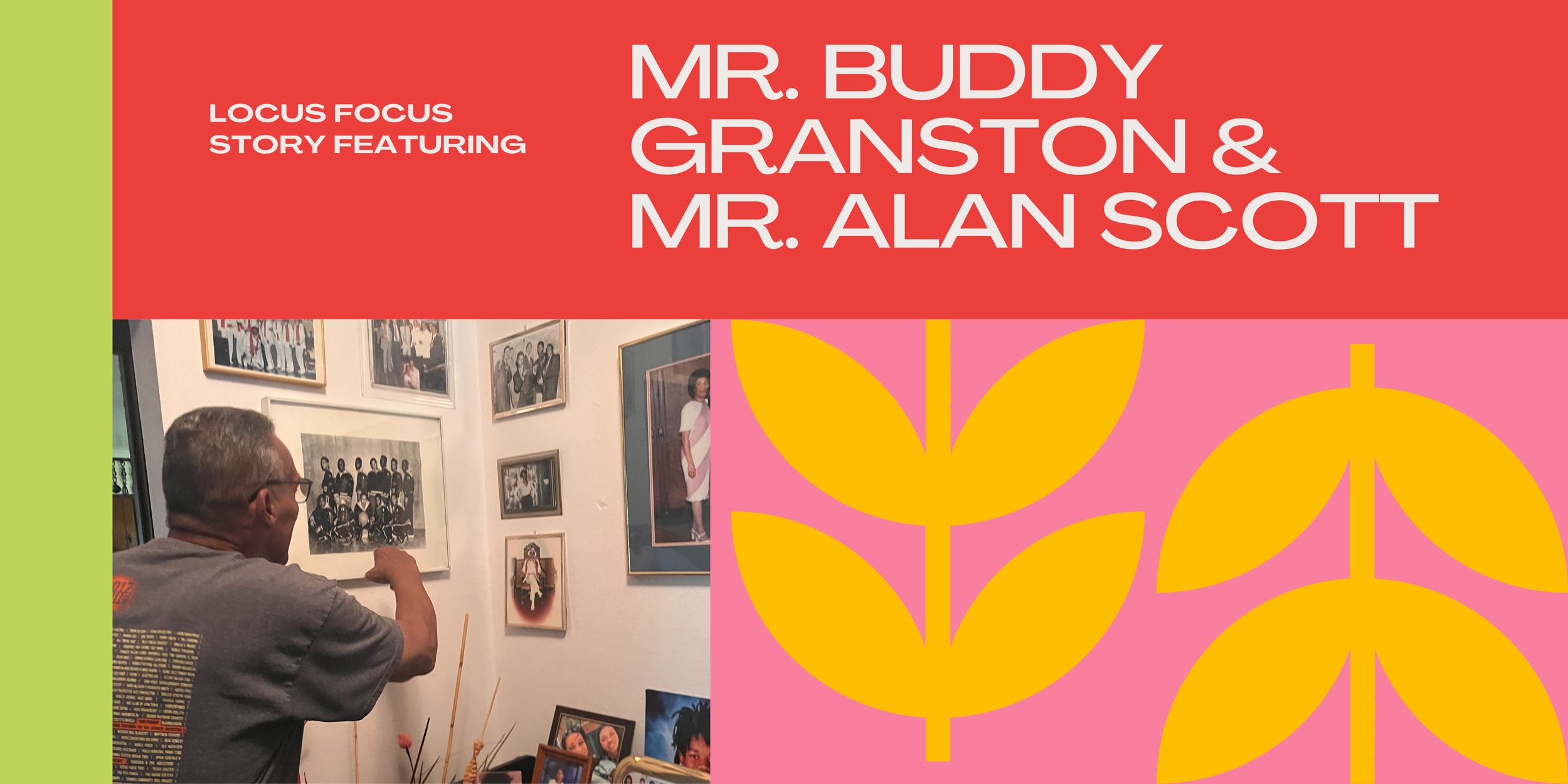
conversation transcription
Buddy
Charles Raymond Granson. I was named after my grandfather. His picture is up there on the wall…My father is right up above. I'm the youngest of his four children
…
Mama Almeta
So, coming here, do you remember your first thought as you either stepped off the bus or got out of a car?
Buddy
I thought when coming to Rochester—…My mother and father, they broke up. So, we came to Rochester on The Black Diamond train. They called it the Black Diamond, at New York Central Station there on Central Avenue. That's when I come here in ‘47. Me, and my brothers, and aunt.
Coming from this small place—well, we came first to Watkins Glen. They broke up, then we moved to Ithaca, and then we came here and it was a lot bigger. Coming here from there, Watkins Glen is a village in Ithaca, it was a real small town.
You know, coming here, that was a real big deal.
Almeta
Yeah, this is a big city.
…
Buddy
Well, when I came into Rochester, Black Diamond train, come here, lived on Ormond Street.
At that time, the area was, it was a Jewish area.
Mama Almeta
Exactly.
Buddy
Because Baden Street settlement was a settlement house for the Jews to acclimate them with the American way. They had synagogues all over. On Ormond Street, Joseph, Hanover—
Mama Almeta
The shul on Leopold. I lived on Leopold Street.
Buddy
Well, yeah that was when most of the Black people I knew were either Christians or, you know, Baptists, Methodists, sanctifying—whatever. But now there was a family that I knew that were Jewish and they were the Jefferies.
Mama Almeta
Yes!
Buddy
And they used to go there; their church was there. I didn't know that, I said, “Wow, I didn't know, no Black Jews.” But, yeah, they were.
…
And Ms. Quamina, who used to tutor people to read and write, because a lot of people, a lot of our people, were illiterate. A lot of people in America were illiterate until we set up our school system. So, that was one of her big things, teaching people to be able to read and write.
I grew up over there [NE Rochester] and we used to call that nickname, ‘The Bottom.’
Mama Almeta
Thank you.
Buddy
The Bottom, because you couldn't go no farther down. There's one thing if you lived in The Bottom, you were at the bottom. You didn't have no where to go but up. That was the nickname back in them days. They called it ‘The Bottom.’ And it was kind of like the bottom because it was downhill from Central Avenue.
Allen
The biggest key is the train station, and everything there. people were traveling then. Those of us that migrated to Rochester got off the train at Holland, or Hudson Avenue, because that's where the train ran. Going to Niagara Falls, or going to New York, or whichever way they were going, because you could only go New York one way, Niagara Falls the opposite way.
Mama Almeta
And Central Avenue was called Central Avenue because that was the hub of the train.
Allen
Oh yeah, because as you come around the corner, go down the hill, right there was Lee's Hotel, a Black bar. On the other side of the bridge was Johnny Rollins. He owned a Black team in the Negro League that used to play just past the old Red Wing Stadium down Jefferson. Actually, they got a school on the property today. But I can remember as a kid going there. We used to walk from, let's say, Kelly Street, Nassau, or even Central to the ballpark. It was a straight shot down Joseph.
Mama Almeta
Exactly, I remember.
Allen
How young are you?
Mama Almeta
Well, I was born in ‘47 and I was with my grandmother every summer until we moved here in ‘59. So, I remember the early 50’s when I was maybe five, six, years old my Uncle George—George Howard—he was a guy who collected trash, and then come home, get suited up, cleaned up, and come out. Tie, suit, Florsheim shoes, hat, and Uncle George—
Allen
And Joseph Avenue was the life.
Mama Almeta
Exactly.
Allen
There was stores, all kind of businesses on the street being active. White, black, purple, green, it didn't make no difference then.
Mama Almeta
Exactly. And that's my point. It was the most diverse area of Rochester for like three decades.
Buddy
And when I come, like you said, it was a Jewish center. Baden Street—in fact, all their [streets] names, Baden Pryor, Herman come from Europe.
…
Mama Almeta
What I recall was not just the many stores and businesses—how everyone felt like family. No matter what you looked like, if you were in that neighborhood, you were family.
Allen
Oh yeah!
Mama Almeta
And the adults, and especially the elders, they'd be watching. They'd be watching over the kids.
Buddy
Today now they have what they call a ‘helicopter family.’ You know, when we were young, we went out and played. You go to the playground, and you play. You be back before the lights come on. Then even after you're back you can be up all down the street around the corner.
But like you say, everybody looked after each other. And you had to definitely respect the older people… If you acted up your parents knew about it
…
We were poor, we were at the bottom.
Mama Almeta
Everybody was at the bottom.
Buddy
Yeah, everybody was at the bottom.
You didn't have to worry about anybody stealing anything because nobody had anything worth stealing.
Mama Almeta
I want to know if any of the, uh, LEAFs have anything they want to ask.
…
Leka
I've been hearing a lot about the Gaylords. What did that come from? How did it originate? What was your experience like?
…
Buddy
How we originally got started, there was a school teacher and she seen we were all hanging out and she was older than us too. She said, “Well, come on,” and she brought us up to Baden Street Settlement. She brought us there, and from there we got involved.
Our brothers, we got involved with Baden Street Settlement House. It had a staff, similar today would be the Boys and Girls Club. They had Black and white staff. Excuse me.
…
I gotta remember her name. I should remember her name 'cause she was a beautiful person and she introduced us to the Baden Street and she said, “Well, you guys come up there. There's things to do. They're doing things up there.”
So that's when me and him [Allen], and his brother, and my brother and some of the guys, we started going to Baden Street. They had programs for after school. They had programs for older kids later than that. But when we started, we were young, it was after school programs. Then you were back at home at 6 o'clock, 5, 6 o'clock.
Then later on they had older programs you could come back in and that's when we joined the clubs. We got together and all that, we'd stay there until 9, 10 and then we'd walk home because most of us lived in the area, so we just walked.
Mama Almeta
So, who came up with the name Gaylords?
Allen
I really can't answer that honestly.
Buddy
Hey, Al, what about her name, the one that brought us up, Lela, you remember?
Allen
Yeah.
Buddy
Maybe she came up with that name.
Allen
I don't remember.
Buddy
She might have.
At the time, Gaylords—’gay’ is a term used now, you know, but gay didn't mean anything. Gay back in them days, back in the 40s and 50s meant—
Allen
Well, see, I also remember there was, for men and women, bars here they could go to. It wasn't no surprise or whatever, even to see you and me in there having a beer.
What I'm saying, there were gay bars for men and women in Rochester. It was nothing new for me to walk down the street, Main Street, and run into a bar. They used to have shows there.
Mama Almeta
For me, the term gay, for decades, meant you're just full of life. You're in the know. You're in the swing.
Allen
And that was our reputation growing up because again, every Thanksgiving for maybe what? 15, 20 years? We used to give a big party. Everybody come, eat, drink and maybe it cost you 20 dollars.
Mama Almeta
Music.
Buddy
Home music. Yes, I remember it.
Allen
I don't know if you've seen any of the tapes.
Mama Almeta
Haven't seen the tapes yet.
Buddy
Well, we had some made up. That's why Antoine—when we gave the bag up, all them tapes and stuff were in that bag. Some of them tapes, not all of them. But that's totally different.
After we got older, we used to give reunions for the people on the east side. And we used to meet at the auditorium on every Thanksgiving. And we'd have a great party, music, food, and people socializing and talking to each other.
And, because then, we were older, we had kids and all that, eventually our kids would come. That went on for a pretty good while.
Allen
Now we go started at the Elks. You know where the auditorium is downtown?
Mama Almeta
Yeah.
Allen
Well, we was next door. Right down there in the basement. Every Thanksgiving. That's before that building got hooked up to the school board so you couldn’t have alcohol. So, if we wanted to throw a party, it had to be milk and water. But that's surprising because next to it, they sell it. But I can't tell you how to run your building.
Buddy
Well, Al, I'm gonna expand on what you were just asking him. How we really got started, one of our buddies owned a bar. It was Billy Wyatt, and we gave a special thing for Allen's mother for what she used to do for us coming up. That was really the start of our reunions at Billy Wyatt's Bar on Joseph Avenue when we honored your mother. And that was the start, before we even went to The Elks.
Yeah, that's how it really started. We were honoring his mother because she used to let us do things together and have a great time and all that.
…So we always had great fun, and we honored her and I think we bought her something nice…Then we went downtown to the auditorium theater and during that time anybody who's who in Rochester would come to our reunions. We had people from the east side, west side, all the Rochestarians. A few judges, The Lords, we had The Undertakers, all that would come out to our reunions. That was a beautiful thing and we had that for about 15 years.
Mama Almeta
And when you mentioned Undertakers—
Allen
Lattimore…
Mama Almeta
These days—Yeah, Lattimore—I'm simply saying these days, most times people don't think about Undertakers or anything. But Undertakers were a foundation of the community, especially over there on the east side.
Buddy
Well, west side too. Actually, Lattimore is on the west side.
Allen
Lattimore—We came from east side because again, at that time, he was the only one.
Mama Almeta
He had all the business.
Buddy
I don't think he's ever suffered hard times.
Mama Almeta
Never. As long as there's people, they gonna make money.
Buddy
They don't now, right?
Allen
Times were better then than they are now. Not a person in here would be homeless. Homeless was B. S. You come and stay at my house. Sleep on the floor of the couch or whatever. That was nothing new. We done that all our lives. We slept at each other's house.
And I grant you, as loudmouth and swearing as we do, and did, when we in certain people's area, a whole different dialect comes. Like I'm an author, know what book to change up.
All I'm saying basically is, life was so beautiful. Downtown was outrageously fabulous. I knew people go downtown to have coffee, to sit outside. That ain't no joke.
Mama Almeta
You got dressed up to go downtown. You didn't go downtown in any old thing.
Allen
Basically, you changed twice a day. After you left work, you took a shower to step out, have a cup of coffee or just yackety yack.
But again, those times, far as the Black neighborhoods, was just like Halloween was. There was places for all kinds of entertainers, big shots or what?
…
Most of the buildings are gone, but there was buildings still standing where entertainments were, dances was going down. Always something going on. Not as much ugliness as there is today. You didn't hear about people getting killed, being beaten up, or somebody beating me up and this and that.
Let's put it this way. A bunch of nightclubs, a bunch of prostitutes, a bunch of pimps, a bunch of people.
Mama Almeta
Don't forget the pool halls.
Allen
Thousands of churches. There was more different ways of going and everybody had something to say. And again, you'd listen. You might not agree, but you'd listen.
Mama Almeta
You'd listen and you respected somebody's beliefs. If you believe your way, fine. I believe my way, but we can still be friends.
Allen
And that was the good part, to have difference. Because you showing me something that I didn't see. I was blind folded this way.
Mama Almeta
Vision gets wider…What about the schools at that time?
Allen
She just died, a teacher, when she first came to come to number nine school. Sewed up my shirts, right there, in class. Miss Young. Number nine was the first job she had.
Mama Almeta
Really?
Allen
Oh, yes.
Mama Almeta
I mean, she got so many honors. Wasn't she a principal?
Buddy
Oh yeah, she was all of that.
Allen
I don't know if she took a principal's job, but I know she was a teacher.
Mama Almeta
Harry Wilson, my grandmother's youngest son, at number nine school—I'm sorry, Harry was the oldest son and Eddie was the youngest son.
Buddy
Eddie Wilson?
Mama Almeta
Yeah.
Buddy
The boxer?
Mama Almeta
Ed can box?
Allen
That's a different one.
Mama Almeta
Educator.
Buddy
Wait, he was a teacher or something?
Mama Almeta
Mm hmm.
Buddy
At nine school?
Mama Almeta
Yep.
Buddy
Oh, okay. This was after, I was older than him.
I remember when I went to night school, we didn't have no Black teachers. And I went from ‘47 to ‘48 until the first one came in. I can remember sneaking out of class and going down there and saying, “Wow, a Black teacher! Wow!” Which was a big thing.
Mama Almeta
It was. It was always a big thing to have a Black teacher. And they were usually top quality. They demanded.
Buddy
Oh yeah, she wouldn't have gotten as far as she got if she wasn't sharp. She was very sharp, no doubt about that.
Mama Almeta
What did you do for entertainment? There's one gentleman that we interviewed, Carl Facciponte. He lived on Joyner Street. He said there were three white families, and he just remembered loving the community because of being able to play marbles with his friends.
Buddy
…It was a melting pot area, you know. We had Eastern Europeans come in. We had a lot of Italians lived in there. I loved them because they always had fruit trees and all that. And grapes to press the wine. We always had great fun with that. They let us pick the fruits and stuff like that.
Mama Almeta
That was a good thing because they allowed us kids to go and pick the fruits and pick little veggies and everything in their backyard because it was always enough. Scarcity had nothing to do with it. It's like, if I got grape vines or fruit trees, just pick what you need. Otherwise, it's gonna rot.
Anyone else have anything you want to ask?
Katie
I am interested in hearing more about the after school programs. What they consisted of, and maybe how they impacted you too.
Allen
The what, dear?
Katie
The afterschool programs with the Gaylords.
Allen
If there was one in my time, I didn't make it.
Buddy
We're talking about like Baden Street Settlement.
Mama Almeta
See that's a total different thing. When you say Gaylords, that's a whole different, that's a spot over here than there's the afterschool, which doesn't connect directly with the Gaylords.
Allen
Baden Street was our second home. We went there until they closed the door. Stayed there and do whatever.
The building had several rooms, so there were several different things going on. Plus, the gym and this and that. Downstairs boxing, crafts, a bake shop. There was activities for all of us. Something to keep our interest.
Mama Almeta
And you have to work hard to keep young people's interest. Even back then.
Allen
Well, even back then, we wanted to be around each other. We wanted to do things…After school, in a half hour, all of us would be there in the building doing whatever.
Mama Almeta
And I'm agreeing with you on that. The statement I was making was more like with young people today being—this stuff on something that you hold in your hand, and you don't have to talk to or engage with anybody else when everything is right on your little screen. It wasn't like that back in the day. We had to connect with one another. Unless you were a bookworm like me, I would just sit and read books.
…Good question, Katie.
Allen
Ms. Stewart was the secretary. And I'm saying that because the guy that took all these pictures was a counselor at Baden Street. Ted Lewis. And everybody there, adults or whoever was running, they had all the respect and everything, but I'm trying to find this lady. She used to live down here off of Genesee Street years ago. I'm sure she's done passed now because she was older than me. She had the respect of every person around her…
Mama Almeta
Anyone else have something while he's looking?
Mandela?
Mandela
How did the after-school programs transform into the Gaylords?
Buddy
Well, like I said, in the beginning, there was a schoolteacher. Her name was Lela, and she got us together because we used to be hanging out on the street in the evenings. She took us up to Baden. She said they had programs and things going on. And so that's where we went, and we became involved after school, for two or three hours. Then later that they had the programs for the older kids. We went from the younger ones, and then we ended up going to the later programs for the older kids. And that's when the Gaylords were formed. I believe she had a lot to do with that name.
Ted Lewis was our counselor. Everybody had a counselor. Every group, we had about 15, 20 different clubs. I’ll put it clubs.
Mama Almeta
Mm-Hmm. And that's what it was. The Gaylords wasn't a so-called gang. It was a club.
Allen
We had our problems.
Mama Almeta
But I mean, in terms of what we call a gang today. It was a club and it was young people coming together. Usually, we made up our own names when I was a teenager at Baden Street, we called ourselves the Aristocrats. We did voter registration drives. We went to different places and asked them to donate food that we could give to the needy families. That was in ‘63, when I was a sophomore.
Allen
Just before the riots.
Mama Almeta
I was pregnant with Christopher while Sonny was throwing Molotov cocktails off of the buildings. And I was like, “You are never going to meet your daddy because they going to kill him!”
Buddy
In ‘63, I got drafted by John F. Kennedy. I got married in January, I got drafted in June in 1963. I was in Kaiserslautern, Germany, and we were on the border…They had the East Germans and the Russians on the other side. I was there in 1963 when they bombed the church in Birmingham and killed—
Mama Almeta
5 little girls.
Buddy
Yeah, like I said, if you want to know some more about me, the Black freedom struggle, they [University of Rochester] have that archive. Check that out.
Allen
Or you can go to the library on the second floor.
…
Buddy
Well, and newspapers, they have all that.
Mama Almeta
Anyone else? Yes, Max.
Max-Yamil
What were the Gaylords?
Buddy
It was a club. A club at Baden Street Settlement…They had a lot of clubs. A lot of clubs. Basically, they took their own name, the Gaylords. Then they had some other brothers that called themselves the Duchamp Brothers. They had the Cavaliers, they had the Dukes.
Mama Almeta
I remember the Cavaliers. Oh, I remember the Dukes, yeah.
Buddy
They had a lot of clubs. And the girls had their clubs, too. Campus Cuties, The Flames, The Lamplighters.
…
If you want to do a true story of the east side, then it would include more than Baden Street. You would have to have the Charles Street Settlement House, the Genesee Settlement House, and the Lewis Street Settlement House.
Allen
And the Black Churches.
Buddy
Mostly Black went to Baden Street, mostly, not all. We had white too. But if you went to the Charles House, the Genesee Settlement House, and the Lewis Street. Then there would be all the people that live in that area.
Mama Almeta
And there were a lot of Latinos in that area.
Allen
Buddy, what was the name of the settlement house on Clinton Avenue? Underneath the Murrahman Building. We used to be there all day long.
Buddy
I don't know the settlement house on Clinton Avenue. I know we had the Charles Street and the Genesee Street over there by Central Park. And the Lewis Street and Baden Street. Them four, from that side of town.
Mama Almeta
I don't remember a settlement house on Clinton Avenue.
Buddy
You're talking about the Mission. That was run by a religious group of people.
Allen
The Open Door Mission?
Buddy
No, no.
We used to go play ball; they had all type of things, arts and crafts there too. It was a mission. I'm trying to think what church organization ran that. Cause we used to go there and make jewelry and do different things. The Inner Lutheran mission? It was called a mission, and it was run by a church group.
…We used to live around there. I think it was called Lutheran Inner Mission. Now that goes way back.
…When I was first old enough to vote…I was 21 then I think…I went to vote and the people at the polls were going to try to ask me to read the—
Mama Almeta
The Constitution!
Buddy
—the Constitution and all that…They were going to almost turn me back from voting. If I couldn't read the Constitution. I'll never forget that. That was the first time when I was 21 and I voted for Nixon.
Mama Almeta
Most people think that those questions were Southern. It was in the North, too.
Buddy
Oh, yeah. Definitely in the North. Both—the killings were in the North, too. But I just want to make sure you understand this. As a young man, I didn't know him. I'm grown up now. So, I voted for Nixon as opposed to Johnson and Kennedy, because Kennedy had Johnson. Johnson was from the South. He was in ‘Cracker Land.’ So, I said, I don't want nothing to do with them people. Nixon had some kind of injustice against women with him at the time. So, I said, and I don't know because I'm just young about politics. I talk with people and all that, but I'm young.
And I said, well, I can't vote for Kennedy because…to help get the votes, he hooked up with Johnson, Lyndon Baines Johnson going down South…
So, I voted for Nixon, which was a bummer, because as it turned out, Johnson was the one that helped with the Civil Rights Act and all that…You never know when you're dealing with politics, it's a hell of a thing.
…
Mama Almeta
Yes, Leka.
Leka
So, a while back, you guys talked about FIGHT. I'm kind of curious about what exactly that is and what your involvement was?
Buddy
The FIGHT organization?
Leka
Yes, does that stand for anything?
Buddy
Yeah, F. I. G. H. T.
F is for Freedom. I, Independence. G, I think that would be God. H T, would that be Honor Today?
Mama Almeta
Yes.
Buddy
I think that would be it. Freedom, Independence, God, and Honor Today.
Allen
Again, explain to her what FIGHT was about. That's what she wanted to know.
Buddy
Oh, well, FIGHT was a community action organization—
Mama Almeta
It came out of, like what happened to you when you went to try to vote.
Allen
Back then, Kodak, Xerox, was very particular about giving jobs to people. Naturally, we've been, and still is on the bottom of the pole. That organization went yakety yak to the top person to make a big difference. Like in Kodak, these big factories and they started hiring minorities.
Mama Almeta
Was it Wilson…the white guy that had the money that helped FIGHT, move on, get started and move on.
…
Allen
That's another chapter I wasn't even aware that you just opened.
Mama Almeta
—Because Wilson, I think he was over at Xerox at the time—
Buddy
Oh right, yeah, well he was the head. I know who you’re talking about.
Mama Almeta
I mean he's got all kinds of things on the east side where his name is on it. Joseph Wilson, on all this stuff. And it started with Saul Alinsky coming here and talking with that white man and a whole bunch of Black including, my little 17-year-old boyfriend, and putting together FIGHT.
And it was Wilson's money and influence that pushed it off the ground because he could see the handwriting on the wall. That man could see the future and knew that it was time for things to change politically, socially, economically.
Allen
That's what Kennedy said too.
Mama Almeta
Exactly.
Allen
And it still ain't changed.
Mama Almeta
Nope, it still hasn’t.
Yes, anyone else?
Yes, Faith, and please speak up.
Faith
What do you miss most about the way things used to be? And I guess a better question would be, when did you notice things start to change from how they were back in like the day. You know, you talk about how people aren't connected anymore.
Allen
They're not changed today.
Faith
They're not changed?
Allen
Not in my eyes.
…
Think about what you just asked me. In the school you go to, is there a program for Blacks to get in?
Mandela
There's like independent scholarship programs that bring in people of color, but is there a specific program? I don’t think so.
Allen
And again, that's what I'm saying. Nothing's changed on its own standing.
The only big change is we don't have all these big corporations. Kodak ain't there. Xerox went down. Bausch and Lomb, Stromberg Carlson, DuPont. We don't have them big industry that was donating to the city doing this and that to keep things going on.
But as far as education, you just told me there is no program even at the U of R. Again, we if you don't educate for one student, that person, hopefully, will maybe pass it on, or do something better.
Again, you don't have to be a Black student or anything like that. The thing is to educate more of us.
Mama Almeta
Level the playing field.
Faith
I mean, that's not quite what I meant. I just meant like socially, how have things changed? Like, we don't have like clubs.
Allen
Well, again, that's me. Because again, I can sit on my front porch now and smoke my weed instead of ducking behind a tree. And believe me, I do that.
But as far as the social, we've always made things for us to have a good time. We were fortunate enough to have certain jobs in this and that and made it on. But Baden Street and what they taught us—it was a place to go with friends and have a good time.
Buddy
And being exposed to a lot of parts of the world that we never would have gotten exposed to.
Mama Almeta
She's got a question.
Katie
What was it like for you to reintegrate into your community after coming back as a veteran? Because I know a lot of times veterans will come back and a lot of their needs are not met. So, I was wondering if you found things in the community that kind of like stepped in to meet needs that you may have developed after, after the war.
Buddy
Well, when I came back—I'm from New York and when I was in the service, I didn't realize that New York had a special meaning to people. And when I got in the service and they said, “That’s Granston, he's from New York.” So, a lot of people looked up to me, white and black. New York. Like, I'm supposed to know something. And so, I thought to myself, “I'm from New York, well maybe I'm supposed to know something. Well, I do know something.” So anyway, I never had that feeling until I left New York when I got into the service.
So, when I come back, after that killing and all that—because I almost went off, me and some other brothers over there, we're on the border, guarding, looking at the East Germans and the communists. Live weapons and all this and they're killing my people back home.
So, when I thought about the riots and all that, I said, “Well, that don't happen in Rochester. I'm a New Yorker. That don't happen in Rochester.”
The riots started—I got out in ‘64 and they started it in ‘64. I got out in June, early June, and it started. That's when it started. That kind of made me feel bad.
…I said, “Damn, that's happening in my home,” New York, you know.
I started reading when I was in the service and I started reading more about history and all that. I know that they say all the things happening down south to hurt people, but they were happening up north, too. And I understood that.
Allen
Well, after the riots, did you see any change in Rochester?
Mama Almeta
Not really.
Allen
No, “not really.” Not at all.
All they build on the east side is them apartments and houses or whatever. Why don't you fix that house up and let him buy it?
Mama Almeta
Or give him the funds.
Allen
Because again, we ain't gaining jack today.
Again, there's less jobs now, so there should be more programs for somebody beginning—a young man or family and this and that. You're gonna pay rent. What the hell's the difference if I'm paying the bank or paying you? I ain't getting nothing out of it, but I'd like to get the house. And it may be 25 years, but I got something to look forward to.
…
Buddy
The way I look at life now, come to the age I've come to—You're always going to have poverty in I say the western world, any world I guess, you're always going to have poverty.
There's always going to be some people—some have—nots and all that. Eventually it's getting to a class type of thing…Our people, the Black people, that struggle in the community, trying to make it better, and get their kids into college and all that. The ones that don't for whatever reason or not—whatever you want to say is the purpose of it—there's always going to be poor people in the world. I can see that. But you try to keep that to a minimum. You try to keep that to a minimum.
We live in a capitalistic type society, and one of our main things is, “Ooohhhh, the communists.”
You know, and I can see now, I didn't realize it then, but a true communist wouldn't be a bad type of people, because of what their philosophy is about…Our capitalist society, it's more individual…it's just a matter of what society you're in and what you want to. There's going to be, as I can see, as long as the western world—the world we live in, the western world, eastern world too—there's always going to be people at the bottom, and there's going to be people at the top.
The more people you can get to the top, to raise up, then the better society is going to be. Now, is our capitalist society the one to be able to do this? Or could it be a communist society? Maybe like in China or Russia? That all depends on who you speak to.
As far as I'm concerned, when I was young, when I come here, there was hardly no Black doctors, no Black lawyers, no Black policemen, no Black judges, no Black firemen, no Black a whole lot of things. But we have got it now.
Allen
Well, there was some.
Mama Almeta
He said there were very few of them. You could count them on one hand.
Buddy
Some weren’t even on a hand. So, I would say, as far as our advancement, I say we've advanced a lot. We've advanced a hell of a lot—
Allen
Where?
Buddy
—But we've still got a long way to go.
Allen
How long has Bull’s Head been up there like that?
Buddy
It's changing now. It's about to change now.
…
Allen
Ever since they put the inner loop in, the city went this way [motioning downwards].
And it's still down here.
Mama Almeta
It was by design.
Allen
How well I know. Across the world, not just Rochester, everywhere they built it, the section that they destroyed was the Black section.
Mama Almeta
Exactly. Always.
Allen
All across the world. And they come up saying now, “We know it was wrong.” That ain't even it. You ain't say you're going to change a damn thing. That's what I'm concerned about.
...
Buddy
We have made advancements. Black people have, and you know one of the reasons why? Because we have some good white folks.
Mama Almeta
And if it weren't for people that were not people of color, I don't believe any of the inroads would have even happened.
Buddy
You know. I say thank God for people like Quakers, people like that who help. Thank God for them people that looked at religion and didn't interpret it the way a lot of people interpret it.
Mama Almeta
As one group is better than another.
Buddy
Yeah, didn't interpret it that way, right. And thank God for them people because we wouldn't have got as far as we got without them. We wouldn't have gotten as far as we got.
I know when I was coming up, some kids were really hungry because they didn't have all these programs and welfare and all, food banks. They didn't have that. They'd be hungry. Ain't no reason for a kid to be hungry now…they'll give them some food somewhere. Somewhere they'll get some food—in America, I don't know outside of America, but I know in America.
…
And it wasn't like that when I was coming up. It wasn't like that. So, we made great strides.
Mama Almeta
And no strides.
Buddy
We’ve made great strides, but it's not over. You know, the struggle is not over. You know, the struggle is not over. That's the way it is.
…
Kelly
I didn't realize that you see names of parks or names of streets and sometimes after years, you lose connection with what the name was connected to. So, this is the first time I heard about Ms. Quamina. Could you share a little bit more about who she was?
Buddy
Well, we grew up in the same area, Al and me, and her. We were all together. I grew up with her son, Benny Andre…I don't know who it was, some her husband or her grandfather, I think, but he went to Catholic school and he became a doctor.
Miss Quamina, I would put her in the same category as…Saint Teresa. I would put her on the same level because she was for real…She knew that it would be better for Black people if we could read or write and that was what her main goal was…She worked out of Baden Street Settlement like that—teaching illiterate people how to read and write. And that was one of her main goals.
She didn't put on airs. She didn't put on none of that. Her son Benny, she wanted him to go to school. She wanted him to be successful. And he was. He went to Aquinas. He went to Duquesne I think, if I'm recalling it right. He's a doctor…He's the doctor that operates.
Allen
Quamina family, didn't they come from the islands?
Buddy
Yeah, her mother and her father, they come from the islands…They were like Mutt and Jeff. She was real tall, slender, and he was short, dark, husky, and all that. But he learned to trade in industry...So, he made enough money to buy a home…Out of all the Black people that lived there on the east side, west side had more educated people…but the east side, they didn't have that many.
But he had a beautiful home, and in the summer, he used to show films and let the kids in the neighborhood go over to his house and watch films, and he'd serve us drinks and all that.
Her mother and father were beautiful, beautiful, beautiful people.
And one more thing I'd like to say…She [Miss Quamina] was like a Mother Teresa. She lived a life dedicated to her people.
Mama Almeta
Yes, indeed.
Buddy
That was her.
I'm going to tell you about one more person, her name hasn't been mentioned. But I grew up with her as one of the greatest people that I ever met in my life. And that was Mildred—
Mama Almeta
Mildred Johnson.
Buddy
Mildred Johnson, yeah…If it wasn't for Mildred Johnson, I wouldn't be here talking to you now.
Katie
Why?
Buddy
Because she got me involved with politics and come off the street to do something in a positive way. A whole lot of people want to do things in a positive way, but they got to be put on the right track to do it. And Mildred Johnson, never forget that. Pay’s good to talk to people.
She knew my mother from coming up to Dayton and all that. I remember when we were out there. I'm working hard. I worked at United Parcel when they first come here, boy they were racist. But anyway, she said, “Granston, Granston, come on, Granston.” I said, “Come on, Mildred I'm working. I just got off work at United Parcel. So, I'm having a beer by the big tree at the Hanover Houses. Come on, man.” She said, “No, there's more. There's more to it. You gotta do more. You gotta do more than that, Granston.” And that's what she called me, Granston.
That got me involved with the FIGHT organization. Meet Minister Florence and all the rest of them. I was involved with that 12 years. And, if it wasn't for that—that got me on a positive note with the Urban League and all that—and if it wasn't for that, I'd have probably been dead a long time ago.
She's a hero of mine. And she was real, too. She took after of her mother, Virginia Wilson. That's what she named the place after [Virginia Wilson Interracial Information and Helping Hand Center]…And she had that much respect for her mother.
She was an angel.
Mama Almeta
Her birthday is August. The family does something at the cemetery on Lake Avenue. Every August on her birthday date.